A deal closes in Salesforce. Sales updates the forecast and moves on to the next quarter. Three weeks later, Finance is still trying to explain why the invoice doesn't match the signed contract, and why the revenue sitting on the books doesn't match either number.
Nobody made a mistake. Nobody broke the deal. The gap was already there before the contract was signed, because it lives in the architecture, not in a specific error.
This is the CRM to ERP revenue gap: the space between what Salesforce records when a deal closes and what NetSuite records when that same deal gets billed and recognized. It shows up as mismatched numbers, a slow close, and a pricing model stuck on the roadmap for a year.
Below is what actually happens in that space, why the usual fixes don't hold, and what a clean handoff looks like when it works.
What actually happens between Salesforce and NetSuite when a deal closes?
Salesforce and NetSuite are built to own different halves of a transaction, and neither one is designed to own the handoff between them. Salesforce is the system of record for the commercial relationship: the opportunity, the quote, the discount approval, the signed terms. NetSuite is the system of record for the financial outcome: the invoice, the general ledger entry, the revenue schedule, the close.
When a rep closes a deal in Salesforce, that record has to become something NetSuite can act on: a sales order, a billing schedule, a set of performance obligations under ASC 606. That translation is where the gap opens up. Salesforce knows the commercial intent — what was sold, at what price, under what terms. NetSuite knows the accounting rules — how that price gets recognized, over what period, under what method. Getting from one to the other requires both kinds of knowledge at once, and most integrations only carry one.
A basic one-time sale with no amendments can often survive this handoff without much friction. The trouble starts the moment a deal has any shape to it: a ramp, a multi-year term, a usage component, a mid-cycle upgrade. Each of those adds a decision that has to be made correctly on the way from Salesforce into NetSuite, and if the integration doesn't know how to make it, someone has to make it by hand.
Why do Salesforce and NetSuite show different numbers for the same deal?
Take a single contract and ask three questions: what did we book, what did we bill, and what did we recognize as revenue? A $500,000 annual deal with a mid-year usage component and a partial-period proration can easily produce three different answers — something like $500K booked, $420K billed so far, and $180K recognized to date. All three numbers can be correct. That's what makes this hard to catch: nothing is broken in the sense of being wrong, it's just that three systems are each answering a slightly different question about the same deal.
Booking is a sales question: what did the customer commit to? Billing is a cash question: what have we invoiced them for so far, given the payment schedule and any usage that's come in? Revenue recognition is an accounting question: how much of that value has actually been earned under ASC 606, independent of when the cash shows up? A contract with a ramp, a proration, or a consumption component will always answer these three questions differently at any given point in the term, because they're measuring different things.
The reconciliation problem isn't that the numbers disagree. It's that most companies don't have a system that can explain, on demand, why they disagree for a specific deal. That explanation lives in the mapping between the commercial terms in Salesforce and the recognition rules in NetSuite, and if nothing owns that mapping, someone in Finance has to reconstruct it by hand at close, every time. For a deeper look at why the underlying math produces genuinely different totals — not just human error — see why booking, billing, and revenue numbers never agree.
Why don't custom integrations, middleware, standalone billing systems, or more headcount fix this?
None of the common fixes for the Salesforce-to-NetSuite gap actually solve it, because they address data movement rather than business logic. Something has to hold the mapping between what Salesforce means by a deal and what NetSuite needs in order to bill and recognize it correctly. Moving data between the two systems faster does not make that mapping happen.
Here is what each approach runs into in practice.
Custom integration
An internal team or contractor builds a point-to-point sync between Salesforce and NetSuite. It works for the deal shapes it was built for. Then a new pricing model launches, or NetSuite runs an upgrade, and someone has to go back into the integration code and adjust it. Every quarter, Finance finds a new data quality issue, IT patches it, and the cycle repeats. The logic never fully stays done because it was never certified against either platform's own upgrade path.
What makes it worse is where the code ends up. Some of it goes into Salesforce — usually Apex triggers or Flow logic added to handle edge cases the CRM was not built for. Some goes into NetSuite, SuiteScript written to catch what the integration sends over and force it into the right shape. Some goes into the integration layer itself. Companies that have been patching this for a few years often have custom logic sitting in two of the three places, sometimes all three, with no single person who can map all of it or tell you with confidence what breaks if you change any piece. When a new pricing model comes in or a contract structure shifts, the question is not just whether the integration handles it — it's which of the three layers needs to change, who owns each one, and whether touching one will break something in the others. That's what turns a pricing decision into a cross-functional project with no clean owner.
iPaaS and middleware
Tools like Boomi, Celigo, or Workato move data between Salesforce and NetSuite faster and more reliably than a fully custom build, which is real progress. But moving data is not the same as understanding it. Middleware can sync a field from an opportunity to a sales order. It generally cannot decide how a mid-term amendment should be prorated under your revenue recognition policy, or how a usage true-up should be allocated across performance obligations. That decision still has to be made somewhere, and if the middleware does not make it, it lands in NetSuite unresolved — or in a spreadsheet.
Standalone billing systems
Adding a dedicated billing platform between Salesforce and NetSuite solves some problems and introduces a new one: a third system of record. Now there are three places a deal's numbers can diverge instead of two, and three integration points to keep in sync instead of one. For companies that want to keep NetSuite as the source of truth for invoicing and revenue recognition, adding a system in the middle works against that goal rather than toward it.
More RevOps or Finance headcount
This is the quiet default most companies land on. People fill the gap manually: reconciling spreadsheets, posting manual journal entries, chasing down why a specific invoice does not match a specific contract. It works until volume grows. Then the company hires more people to do the same reconciliation at a larger scale, which scales cost without scaling capability.
None of these fixes is wrong to try. They are just aimed at the wrong layer of the problem. The gap is not a data movement problem. It is a business logic problem: something has to hold the mapping between what Salesforce means by a deal and what NetSuite needs to bill and recognize it correctly, and that mapping has to survive contract changes — not just the initial close.
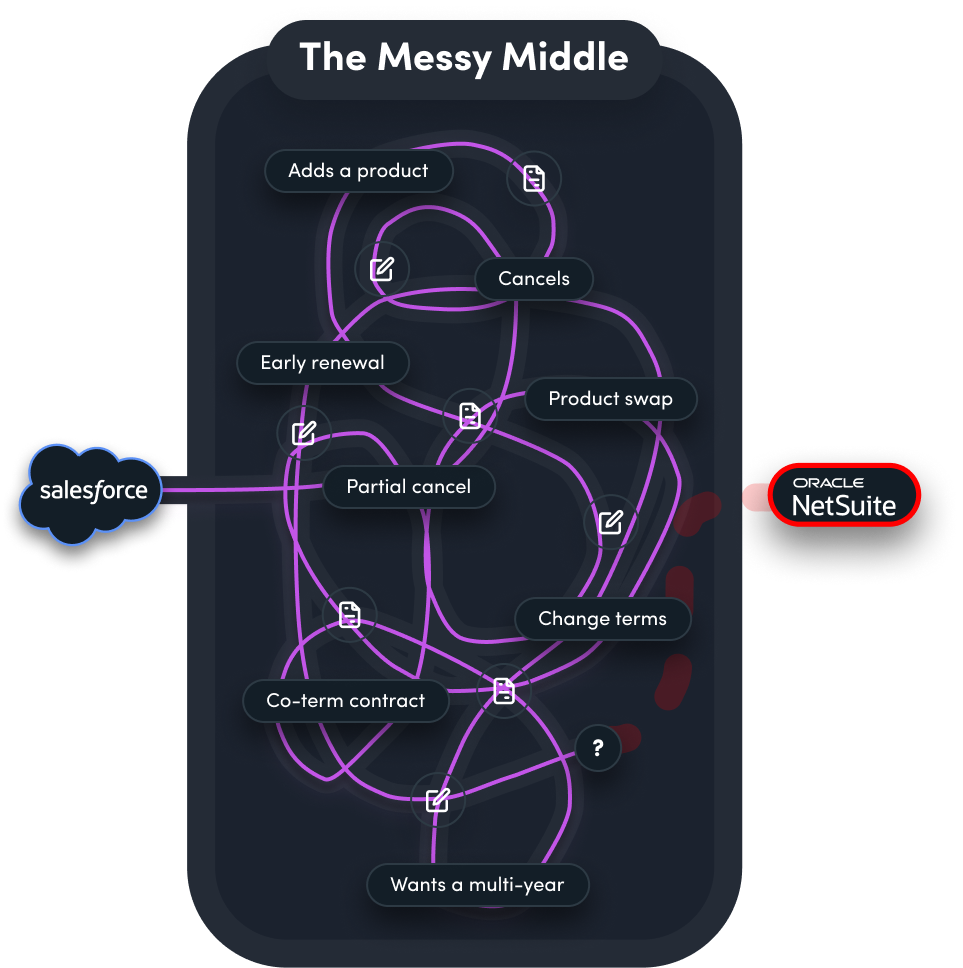
What happens when a deal changes? The messy middle of amendments and renewals
The handoff between Salesforce and NetSuite is hardest to get right at the moment a deal changes, and deals change constantly: upgrades, downgrades, co-terms, renewals, mid-cycle usage true-ups. Each of these exposes the same underlying gap, just at a different point in the contract lifecycle.
Here's a common pattern. A customer upgrades mid-term. In Salesforce, that's a straightforward amendment: new line items, a new price, an effective date. In NetSuite, that same change has to become a new billing schedule, a revised set of performance obligations, and a revenue recognition adjustment — none of which follows automatically from the Salesforce edit. When there's no logic in place to carry that translation, the common workaround is to cancel the original transaction in NetSuite and rebuild it from scratch: a cancel-and-rebill cycle. It works, but it's manual, it's error-prone, and it has to be repeated for every amendment on every contract.
Multiply that across a full customer base with regular upgrades, renewals, and usage-based components, and close stops being a reporting exercise and becomes a reconciliation project. Finance spends the days before close hunting down which contracts had mid-cycle changes, whether NetSuite reflects them correctly, and whether the revenue recognized so far still lines up with the amended terms. That's audit risk building quietly in the background — not because anyone did anything wrong, but because the system architecture never gave contract changes a clean path from Salesforce into NetSuite.
Who actually owns this problem?
The honest answer is that no single team owns it — and that's by design, not by accident. Sales and RevOps, who report to the CRO, own the deal from quote through close. Billing operations, who typically report to the VP of Operations or the CFO, own invoicing. Revenue recognition, which reports to the CFO, owns the numbers that hit the financial statements. IT or BizApps, reporting to the CTO or COO, owns the pipes connecting all of these systems together.
When a number doesn't tie out, every one of these teams has a legitimate reason it isn't their fault. Sales closed the deal correctly in Salesforce. Billing invoiced according to the schedule they were given. Finance recognized revenue according to the rules they were given. IT built the integration to the spec they were given. Everyone did their job, and the gap still exists — because it was never anyone's job to own the translation between systems, only the systems on either side of it.
That's a structural problem, not a performance problem, and it explains why throwing more effort at any single team rarely closes the gap. The fix has to sit at the layer between the teams, not inside any one of them.
What does a clean Salesforce-to-NetSuite handoff actually look like?
A clean handoff means every commercial event in Salesforce — whether it's a new deal, an amendment, a renewal, or a usage true-up — arrives in NetSuite already carrying the context Finance needs to bill and recognize it correctly, without a person in the middle reconstructing that context by hand.
That requires a dedicated logic layer between the two platforms, not bolted onto either one. Several things have to be true of that layer for it to hold up in practice.
It has to carry business logic, not just field mappings. Copying a value from an opportunity into a sales order is data movement. Deciding how a mid-term amendment should be prorated under ASC 606 performance obligation rules — and translating that decision into the correct NetSuite revenue schedule — is business logic. Most integration approaches do the first thing and leave the second for someone else to handle.
It has to be certified against both platforms so it keeps pace with Salesforce and NetSuite releases rather than breaking against them. A custom build certified against nothing has to be retested and patched after every upgrade. A certified product updates alongside the platforms it connects, which means the maintenance cycle that currently consumes IT bandwidth every quarter largely goes away.
It has to govern the full contract lifecycle, not just the initial close. The initial close is actually the easy part. Amendments, renewals, and usage true-ups are where most integrations break down, because they were designed for a deal's starting state, not its evolving one. A clean handoff architecture handles contract changes the same way it handles the original deal: with logic that already knows what to do, rather than a manual process that has to figure it out every time.
It has to produce full traceability from the commercial event in Salesforce to the recognized revenue line in NetSuite. The reconciliation problem at close isn't just that the numbers differ — it's that no one can explain why they differ for a specific contract without reconstructing the history by hand. Full traceability means that explanation already exists, automatically, from the moment the deal event was created.
When those conditions are met, the cancel-and-rebill cycle goes away. Contract changes flow from Salesforce into the correct NetSuite sales transaction and revenue schedule without a person in the middle. Close becomes validation rather than reconstruction.
Continuous Control is built to be that logic layer — certified on both Salesforce ARM and NetSuite ARM, governing the full contract lifecycle, and producing traceability across every commercial event. Book a demo to see it with your deal structures.
Frequently asked questions
Why don't Salesforce and NetSuite sync automatically?
Salesforce and NetSuite don't sync automatically because they're built to own different parts of a transaction: Salesforce owns the commercial relationship (quotes, terms, approvals), and NetSuite owns the financial outcome (invoices, revenue recognition, the general ledger). Neither platform is designed to carry the business logic needed to translate a commercial event into a financial one, so that translation has to be built separately — whether through custom code, middleware, or a certified product designed for that specific handoff.
What is the messy middle in quote-to-cash?
The messy middle refers to what happens when a deal changes after it's initially booked — through an amendment, upgrade, downgrade, co-term, or renewal. Without dedicated logic to carry that change from Salesforce into NetSuite, the common workaround is a manual cancel-and-rebill cycle in the ERP, along with manual revenue adjustments and spreadsheet tracking to keep everything reconciled. It's called the messy middle because it sits between the CRM and the ERP, and it's where most reconciliation pain concentrates at close.
Why do booking, billing, and revenue numbers differ for the same deal?
Booking, billing, and revenue answer three different questions: what the customer committed to, what's been invoiced so far, and how much value has actually been earned under ASC 606. A contract with a ramp, proration, or usage component will produce different answers to each question at any given point in the term — and all three can be correct simultaneously. The reconciliation challenge is explaining why they differ for a specific contract, which requires a clear mapping between commercial terms and recognition rules.
Can middleware or iPaaS tools close the gap between Salesforce and NetSuite?
Middleware and iPaaS tools can move data between Salesforce and NetSuite reliably, which is a real improvement over a fully custom build. What they generally can't do is apply accounting judgment: deciding how a mid-term amendment should be prorated, or how a usage true-up should be allocated across performance obligations. Those decisions still have to be made somewhere, and if the middleware layer doesn't make them, they land unresolved in the ERP or get handled manually in a spreadsheet.
Why does closing the books take so long when Salesforce and NetSuite are both in use?
Close takes longer when there's no dedicated logic connecting Salesforce and NetSuite because Finance has to manually hunt down which contracts changed mid-cycle, confirm those changes are reflected correctly in NetSuite, and reconcile revenue recognized against amended terms. Each of those steps is a manual reconstruction of a mapping that, in a clean handoff, would already exist automatically from the moment the deal changed in Salesforce.