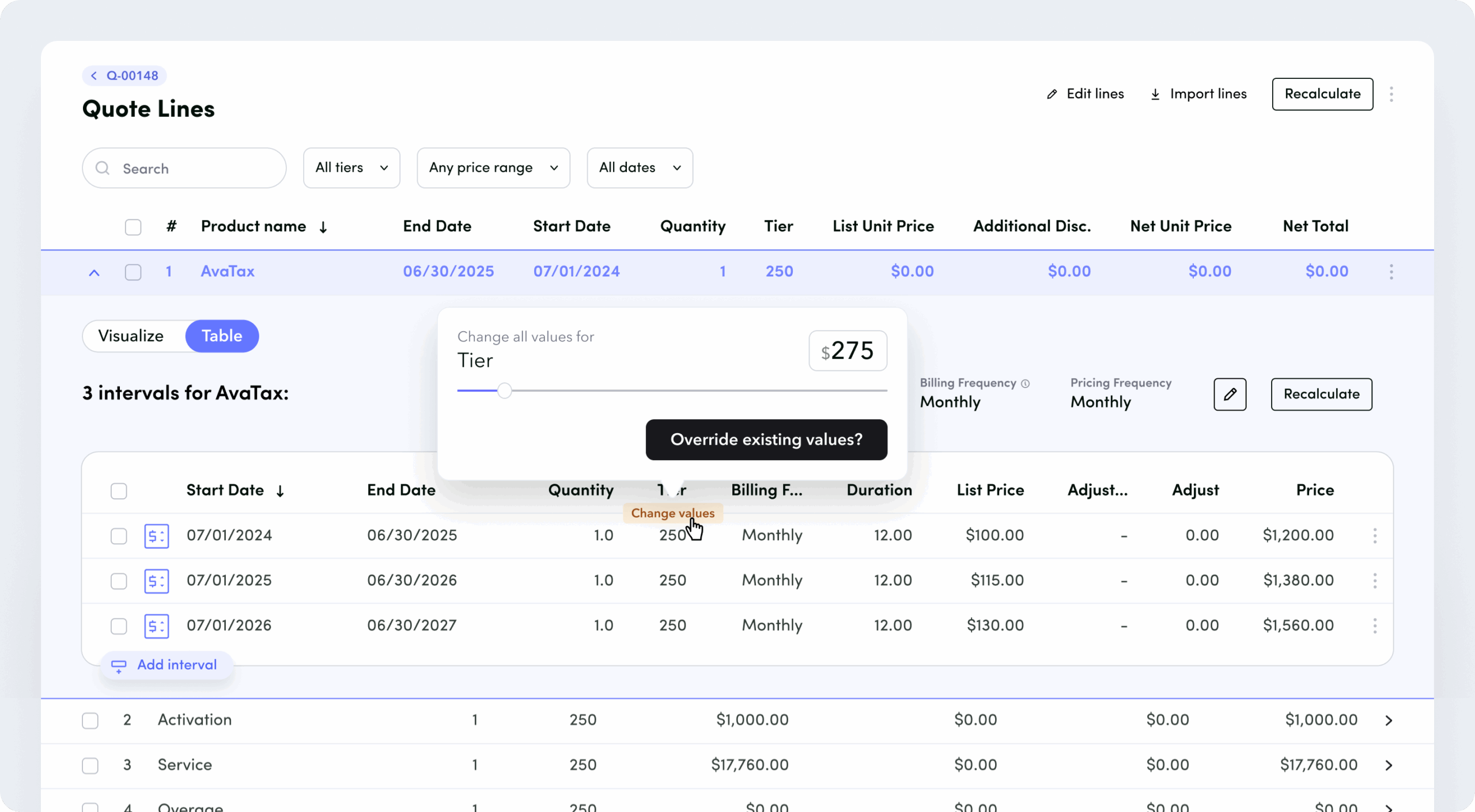
A multi-year ramp deal looks clean the day it's signed. The quote is approved, the contract value is booked, and the sales team moves on. Then the invoices go out wrong, the revenue numbers don't match the booking, and finance spends the last week of the quarter reconciling a deal that closed months ago.
This is the pattern that defines enterprise quoting. Multi-year ramp deal quoting is hard not because the quote itself is complicated to build, but because a ramp deal encodes a set of future events (price increases, product additions, mid-term changes) that every downstream system has to interpret correctly, over and over, across the entire contract lifecycle. Most systems don't. The complexity that got compressed into a single clean quote gets paid back later as billing errors, revenue misstatements, and manual finance work.
And the quote is only the beginning. The real difficulty lives in the contract lifecycle: the amendments, co-terms, upgrades, downgrades, renewals, and true-ups that reshape a ramp deal after it's signed. Each of those events forces a recalculation that most systems can't perform cleanly, and under ASC 606 each one can change how and when revenue is recognized. This article breaks down why ramp deals create downstream pain, where the data actually breaks across the lifecycle, and what separates enterprises that handle ramps cleanly from the ones stuck reconciling every quarter.
What is a multi-year ramp deal?
A multi-year ramp deal is a contract in which pricing, quantities, or products change on a scheduled basis across a multi-year term, rather than staying flat. A typical structure prices Year 1 low to reduce the buyer's initial commitment, then escalates in Years 2 and 3 as adoption grows. It is the standard shape of enterprise SaaS "land and expand."
A common example: a three-year contract with fees of $1M in Year 1, $2M in Year 2, and $3M in Year 3. The buyer commits to the full $6M, but pays and consumes on a rising schedule. Ramps can also stack additional dimensions on top of price, including seat counts that grow, products that unlock in later years, and usage tiers that shift as commitments increase.
The appeal is obvious. A ramp lowers the barrier to signing a large multi-year commitment, aligns cost with the buyer's expected adoption curve, and inflates total contract value. The problem is that the ramp schedule is a promise about the future, and that promise has to be honored by billing systems and accounting systems that were often built to handle flat, predictable contracts.
Why does ramp complexity break downstream instead of at the quote?
Ramp complexity breaks downstream because the quote captures intent, but billing and revenue recognition have to execute that intent on a schedule, correctly, every period, for the life of the contract. The quote is a single event. Everything after it is recurring, and every recurrence is a chance for the data to drift.
Here's the disconnect. When a rep builds a ramp quote in a CRM or CPQ tool, the output is a set of line items and a total contract value. That's what sales cares about. But the systems downstream need something the quote often doesn't carry cleanly: the timing logic. Which fee applies in which period. When the price steps up. How a mid-year change reallocates the remaining schedule. When revenue should be recognized versus when the customer is billed.
That timing logic is where ramp deals live or die, and it's exactly the part that tends to get lost in the handoff between the system where the deal is sold and the system where the money is recognized. The result is three different numbers for the same deal: the amount booked, the amount billed, and the amount recognized as revenue rarely line up on their own.
The straight-line trap: why billing and revenue diverge
Under ASC 606, the revenue accounting standard, a ramp deal usually cannot be recognized the way it is billed. If the service is delivered consistently across the term, revenue is recognized evenly (straight-line) across the full contract, regardless of the ramped payment schedule.
Apply this to the $1M / $2M / $3M example. The customer is billed on the rising schedule, but revenue is recognized at $2M per year (the $6M total spread evenly across three years). In Year 1, the company recognizes more revenue than it bills, creating unbilled receivables (a contract asset on the balance sheet). In Year 3, it bills more than it recognizes. This is not an edge case. It is the default accounting treatment for ramped contracts, and it means billing and revenue schedules are designed to diverge.
Unless both schedules (what the customer owes and what the business recognizes) are held and kept reconciled, the difference becomes manual work.
Where multi-year ramp deals actually break: four failure points
Ramp deals fail downstream in four predictable places. Each one starts as a small data problem at the quote stage and compounds into a finance problem later.
1. Mid-term amendments break the ramp schedule. The single biggest source of ramp pain is change. Enterprise contracts rarely survive three years untouched: customers upgrade, add products, co-terminate a new purchase with the existing contract, or renegotiate. When a deal changes mid-term, the original ramp schedule has to be recalculated, the remaining value reallocated, and the change classified for accounting purposes, because under ASC 606 the treatment determines what revenue lands in which period. This is where most ramp deals actually come apart, and it's important enough to take on its own below.
2. Co-terms and renewals scramble the timeline. Enterprises consolidate contracts so everything renews on one date. That's operationally sensible and a data nightmare. Co-terming a mid-year add-on to an existing ramp means prorating the new item, aligning it to the master end date, and folding it into a schedule that's already mid-ramp. Every co-term is a re-computation, and every re-computation is a chance for the billed amount and the recognized amount to drift apart.
3. Revenue timing gets misallocated. As covered above, ramped billing and straight-line revenue recognition diverge by design. When the ramp schedule isn't carried cleanly from the quote into the accounting system, finance ends up manually building deferred revenue waterfalls and unbilled receivable entries in spreadsheets. Manual entries are where audit risk lives.
4. Line-item and SKU explosion. A single ramped, multi-product, multi-year deal can generate dozens of line items once every price step, product, and period is expanded. Multiply that across an enterprise book of business and you get what practitioners call SKU explosion: so many line items that no human can eyeball whether the invoice is right. Errors hide in volume.
Why the contract lifecycle is where ramp deals really break
The contract lifecycle is where ramp deals really break because a quote is a single moment, but a contract is a living record that gets amended, co-termed, renewed, and trued-up for years, and every one of those events forces a recalculation of the ramp schedule that most systems cannot perform without breaking the audit trail. The quote sets the plan. The lifecycle is what actually happens, and it rarely matches the plan.
Consider the events a typical three-year ramp deal absorbs before it ends: a mid-year seat expansion, a new product added in Year 2, an early renewal negotiated at a discount, a downgrade after a reorganization, a co-termed add-on aligned to the master end date, and a usage true-up at each anniversary. Each event changes the transaction price, the schedule, or both. And under ASC 606, each one triggers a classification decision that determines the revenue treatment. Get the classification wrong and you recognize revenue in the wrong period, which at enterprise scale is not a rounding error but a potential restatement.
The three ways ASC 606 treats a contract modification
Under ASC 606, every mid-term change runs through a two-part test (does the modification add distinct goods or services, and is the price at standalone selling price?) that sorts it into one of three treatments. Each recognizes revenue differently, and the classification is prescribed by the standard, not left to preference.
Treatment 1: A separate contract (prospective). When the modification adds distinct goods or services priced at their standalone selling price, it is accounted for as a new, standalone contract. The original contract and its ramp schedule are untouched, no revenue already recognized is adjusted, and the new items are recognized going forward. This is the cleanest case, and the one finance teams most often get wrong by defaulting to "modification" when a clean upsell at standalone price is actually a new contract.
Treatment 2: Termination and replacement (prospective). When the added goods or services are distinct but not priced at standalone selling price, the original contract is treated as terminated and combined with the modification into a new contract. Revenue recognized to date is not restated, but the remaining unrecognized consideration from the original ramp plus the new consideration is pooled and reallocated across the remaining performance obligations from the modification date forward. The ramp schedule you started with no longer exists; a new blended schedule replaces it.
Treatment 3: Cumulative catch-up (retrospective in calculation). When the modification does not add distinct goods or services (it changes an obligation that is a single, continuous, partially satisfied performance obligation, which is exactly what a multi-year software subscription usually is) it is folded into the existing contract. The transaction price is recalculated, applied to the updated measure of progress, and the difference between what should have been recognized to date and what actually was is booked as a single adjustment in the current period. This treatment draws the most auditor attention, because one catch-up entry can pull a material amount of revenue into or out of a single quarter.
The practical problem: a multi-year ramp deal that is treated as a single continuous performance obligation (the common case) routinely lands in Treatment 3, which means a mid-term change doesn't just adjust future periods, it reaches back and restates the cumulative revenue position in the period of the change. That is precisely the kind of calculation that cannot be done by canceling and rebilling the contract, yet cancel-and-rebill is exactly the workaround that systems unable to model modifications fall back on. Cancel-and-rebill destroys the schedule history, erases the audit trail auditors expect, and makes the catch-up calculation impossible to defend.
Why the lifecycle compounds the ramp problem
A flat annual subscription that gets modified is a manageable calculation. A ramp deal that gets modified is a harder one, because the modification has to be reconciled against a schedule that was already changing on its own. The reallocation isn't spreading a new price evenly; it's re-deriving the ramp steps for the remaining term, recomputing the straight-line revenue schedule against the new total, and recording whichever of the three ASC 606 treatments applies, all while preserving the original schedule for audit. Now multiply that by every lifecycle event across every ramp deal in the book of business. This is why finance teams end up rebuilding deferred revenue waterfalls by hand every quarter: the systems that hold the contracts can't model what happens to a ramp when the contract changes, so the humans do it in spreadsheets.
Where does the Salesforce revenue stack hand off to the ERP?
Salesforce CPQ, and its successor Revenue Cloud Advanced (now aligned with Agentforce Revenue Management), are built to do something specific and do it well: configure, price, and close the deal inside the CRM where the sales team already works. What they are designed to own is the front of the revenue process. Recognizing that deal's revenue lives in the ERP, and the handoff between the two is where multi-year ramps need help. This is an architectural boundary, not a shortcoming of any one product.
That boundary matters more now, not less. Salesforce moved CPQ to end-of-sale in March 2025 and is directing new investment toward Revenue Cloud Advanced and Agentforce Revenue Management, a broader revenue lifecycle platform built natively on the Salesforce core. This is a positive modernization of the front of the revenue stack. But whichever generation of the Salesforce stack a company runs, the quote is still created in Salesforce and revenue is still recognized in the ERP. Modernizing the CRM side doesn't remove the boundary between the system that sells the deal and the system that recognizes it; it makes a clean handoff across that boundary more valuable.
The Salesforce quoting layer handles a clean, flat quote smoothly. The territory that asks more of any CRM-based quoting tool is exactly where ramp deals live: multi-year schedules, ramped and tiered pricing, prepaid commitments drawn down over time, and mid-term amendments that require reallocating a schedule rather than writing a new one, all of which ultimately have to reconcile with how revenue is recognized in the ERP. Teams often bridge that stretch with custom code, manual overrides, and RevOps effort. Those bridges work until a pricing model changes or a platform updates, and then the custom logic needs rebuilding. The goal isn't to replace the Salesforce quoting layer; it's to give it a durable connection to the ERP so that effort isn't repeated every time something changes.
The point is architectural, and it's nobody's fault. The quote is created in the CRM, revenue is recognized in the ERP, and billing can live in either. The connection between sold intent and recognized outcome is the part that has to be built and maintained, and it's the part that carries the most weight for a multi-year ramp. For a flat annual subscription, a light handoff is enough. For a multi-year ramp with mid-term changes, that handoff is exercised every quarter-end for three years, which is why it pays to make it robust rather than manual.
How enterprises extend Salesforce to handle ramps cleanly
The fix is not to replace the Salesforce and NetSuite systems that already work. It's to close the gap between them so the ramp schedule created at the quote stage survives, intact and correct, all the way through billing and revenue recognition, with Salesforce remaining the source of truth for the deal. Two capabilities make the difference.
First, capture the full lifecycle logic upstream, at the quote. The ramp schedule, the timing of each price step, the rules for how a mid-term change reallocates the remaining term, all of it should be encoded when the deal is structured, not reconstructed by finance after the fact. This means extending the Salesforce quoting layer to handle multi-year, ramped, and hybrid structures natively rather than through customizations someone has to maintain, so the complex deal closes cleanly and carries its own logic forward.
Second, carry that logic cleanly into the system of record for revenue. The billing schedule and the straight-line revenue schedule both need to land in the ERP accurately, with mid-term amendments flowing through as proper contract modifications instead of cancel-and-rebill cycles. When the connection between the CRM and the ERP understands accounting rules (not just how to move data), invoices come out right and revenue recognizes correctly without manual journal entries.
This is the approach behind Continuous: rather than adding a standalone billing system or pulling finance out of the ERP, it embeds revenue infrastructure natively inside Salesforce and NetSuite, extending the Salesforce quoting layer (CPQ today, Agentforce Revenue Management going forward) to close complex ramped deals and delivering clean, schedule-aware data into NetSuite Advanced Revenue Management for accurate recognition. Salesforce stays the source of truth for the deal and NetSuite stays the system of record for revenue. The result companies report is concrete: pricing and packaging changes that used to take weeks compress to days, and in some cases over a thousand lines of custom integration code get retired because the logic no longer has to be hand-built and maintained.
The test for any approach is simple. When a customer amends a three-year ramp deal in month 14, does the change flow automatically into correct invoices and correct revenue, with a full audit trail, or does someone open a spreadsheet? If it's the spreadsheet, the complexity you compressed into that clean quote is still waiting to be paid.
Key takeaways
- Ramp deals defer complexity, they don't remove it. A clean multi-year quote encodes years of future timing logic that downstream systems have to execute correctly every period.
- Billing and revenue recognition diverge by design. Under ASC 606, ramped billing and straight-line revenue recognition rarely match, creating contract assets and unbilled receivables that have to be tracked.
- The contract lifecycle is the real problem, not the quote. Amendments, co-terms, renewals, and true-ups each force a ramp-schedule recalculation, and under ASC 606 each triggers one of three modification treatments (separate contract, termination and replacement, or cumulative catch-up) that change which revenue lands in which period.
- Cancel-and-rebill is the trap. Systems that can't model a modification fall back on canceling and rebilling the contract, which destroys the schedule history and the audit trail exactly when auditors need them.
- The Salesforce stack sells the deal; the ERP recognizes it. The CRM-to-ERP boundary, not any single product, is where ramp deals fall apart, and modernizing toward Agentforce Revenue Management makes a clean handoff across that boundary more valuable, not less.
- The fix is continuity, not replacement. Capture lifecycle logic at the quote and carry it cleanly into revenue recognition, without adding another standalone system.
Frequently asked questions
What is a ramp deal in SaaS?
A ramp deal is a multi-year contract in which pricing or quantities increase on a scheduled basis across the term, rather than staying flat. Year 1 is typically priced low to ease the initial commitment, with fees escalating in later years as adoption grows. It is the standard structure for enterprise land-and-expand sales.
Why are multi-year ramp deals hard to quote?
The quote itself is straightforward to build. The difficulty is that a ramp deal encodes future timing logic (when prices step up, how mid-term changes reallocate the schedule, when revenue is recognized versus billed) that downstream billing and revenue systems must execute correctly every period for the life of the contract. That logic often gets lost in the handoff between the CRM and the ERP.
How is revenue recognized on a ramp deal under ASC 606?
If the service is delivered consistently across the term, ASC 606 generally requires revenue to be recognized evenly (straight-line) across the full contract, regardless of the ramped billing schedule. This means billing and revenue diverge: in early years the company recognizes more than it bills (creating unbilled receivables), and in later years it bills more than it recognizes.
How does the Salesforce revenue stack work with the ERP on ramp deals?
The Salesforce quoting layer (CPQ, and its successor Agentforce Revenue Management) is designed to configure, price, and close the deal inside the CRM, which it does well. Revenue for that deal is recognized in the ERP. Multi-year ramps need a clean handoff across that CRM-to-ERP boundary, because the schedule, mid-term changes, and drawdowns all have to reconcile between where the deal is sold and where revenue is recognized.
What causes billing errors on ramp deals?
The most common causes are mid-term amendments that force schedule recalculations, co-terms and renewals that scramble the timeline, revenue timing that gets misallocated when the ramp schedule isn't carried cleanly into the ERP, and line-item explosion that hides errors in volume.
How does ASC 606 treat a mid-term change to a ramp deal?
Every modification runs through a two-part test: does it add distinct goods or services, and is the price at standalone selling price? That sorts it into one of three treatments. If distinct and at standalone price, it's a separate contract recognized prospectively. If distinct but not at standalone price, the original contract is terminated and replaced with a blended schedule going forward. If not distinct (the usual case for continuous multi-year subscriptions), it's folded into the existing contract with a cumulative catch-up adjustment booked in the current period.
Why is cancel-and-rebill a problem for ramp deals?
When a system can't model a contract modification, teams often cancel the existing contract and rebill it from scratch. This destroys the original ramp schedule, erases the audit trail auditors expect, and makes the ASC 606 cumulative catch-up calculation impossible to defend, turning an accounting requirement into an audit risk.