A new pricing model takes about ten minutes to sketch on a whiteboard. A rep draws a usage curve, someone adds a prepaid credit pool, a finance lead pencils in an annual minimum, and everyone nods. Then it takes months to actually operationalize, because that ten-minute sketch has to survive quoting, billing, revenue recognition, and the ERP before a single invoice goes out correctly.
That distance between the whiteboard and the working system is where quote-to-cash complexity lives. Usage pricing, prepaid credits, minimum commitments, and hybrid commercial models open real growth. They also introduce operational load across every system that touches a deal, and most of that load stays invisible until a pricing model is already live and something breaks at quarter-end.
This article walks through where modern pricing complexity actually concentrates across the quote-to-cash lifecycle, how finance leaders are adapting their systems and processes, and the warning signs that a new pricing model is about to overwhelm manual work. You will leave with a set of practical questions to pressure-test any new pricing model before it becomes an operational problem.
Why does a pricing change that takes minutes to sketch take months to operationalize?
A pricing change looks simple because the commercial idea is simple. Operationalizing it is hard because that one idea has to be expressed correctly in different systems and processes, each owned by a different team, each with its own rules. The concept moves in minutes. The plumbing moves in quarters.
Think about the "same deal, three numbers" problem that teams know well. A sales booking closes at $500K. Billing invoices $420K across a ramp. Revenue recognizes $180K in the current period under the contract terms. All three numbers are correct. They only look wrong because the quote, the invoice, and the revenue schedule were produced by systems that were never taught to agree on what the deal actually was.
The way companies monetize changed faster than the systems meant to support it. According to Metronome's State of Usage-Based Pricing 2025, 77% of the largest software companies now run some form of usage-based pricing, and nearly half of the companies that adopted it did so in just the last two years. The commercial models raced ahead. The quoting, billing, and revenue systems and processes underneath them did not.
What is quote-to-cash complexity?
Quote-to-cash complexity is the operational cost of carrying a single commercial agreement correctly across every stage of the revenue lifecycle: quoting, ordering, billing, and revenue recognition, wherever you may draw the line with ERP. It grows every time a pricing model adds a variable that one of those stages was not designed to handle.
Quote-to-cash (Q2C) is the end-to-end process that runs from generating a customer quote through to collecting and recognizing revenue. For a flat annual subscription, the process is close to linear. Sales quotes a fixed number, billing invoices that number, and revenue recognizes it ratably. Each stage passes a clean, predictable value to the next.
Modern pricing breaks that clean handoff. A usage component means the billable amount is not known at quote time. A prepaid credit pool means the invoice and the revenue schedule move on different clocks. A minimum commitment means a true-up has to be calculated, quoted, billed, and recognized correctly, often mid-term. Each variable multiplies the number of states a single contract can be in, and the systems have to track all of them.
Where does quote-to-cash complexity actually live?
Quote-to-cash complexity does not sit in one system or process. It concentrates at all points in the lifecycle: the quote, the invoice, the revenue schedule, and wherever the handoff is into the ERP. Understanding where it lives is the first step to catching it before it turns into manual work.
At the quote
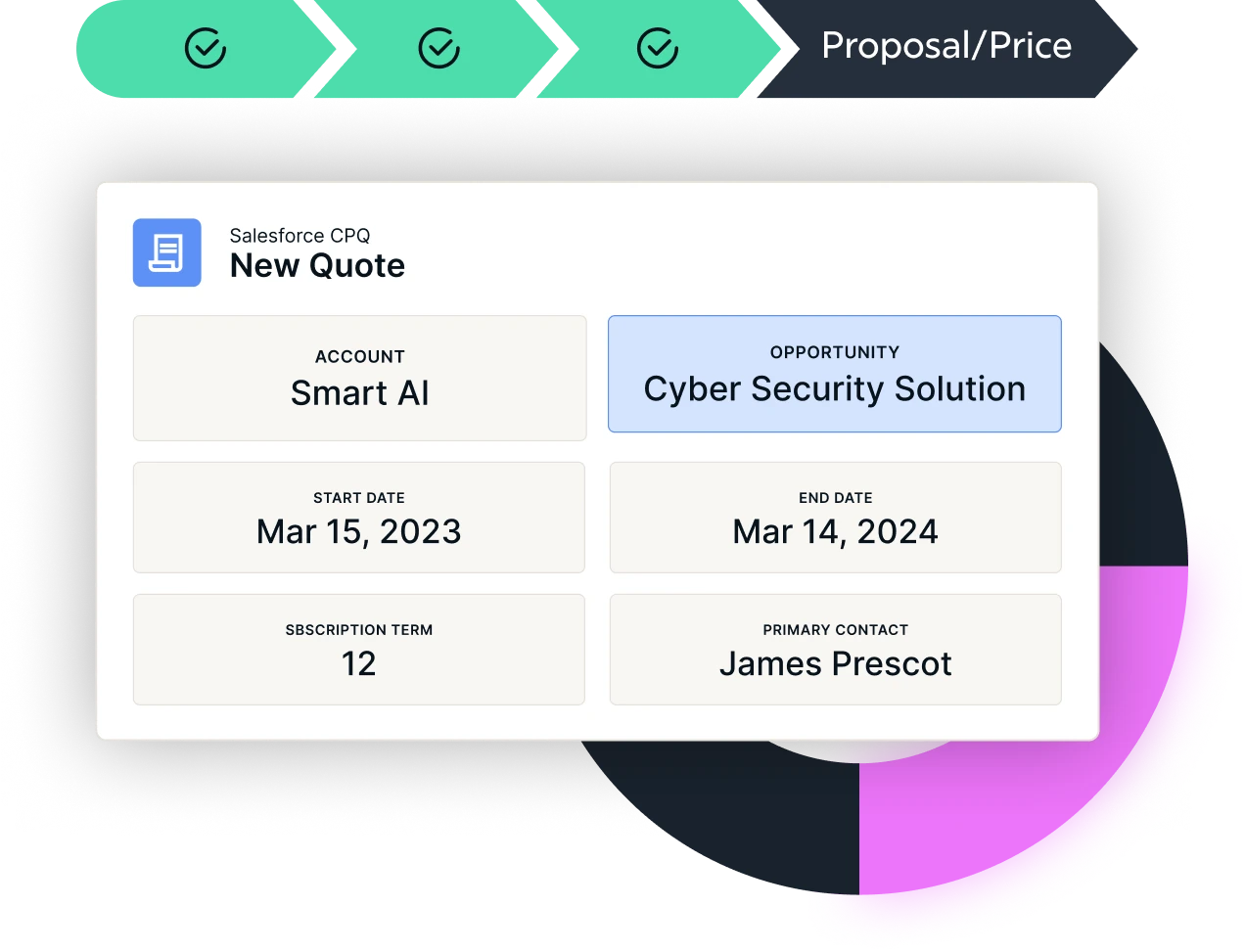
Complexity starts at the quote, because the quote is where commercial intent gets encoded. This is the Salesforce quoting layer, CPQ today and Agentforce Revenue Management going forward. When a rep configures a hybrid deal with a platform fee, a usage rate, a ramp, and an annual minimum, the quoting layer has to capture all of it in a structure that downstream systems can actually read. If the structure is incomplete, the deal is technically closed but not yet operable.
Salesforce retired Salesforce CPQ from new sales in March 2025 and is moving customers toward Revenue Cloud Advanced and Agentforce Revenue Management. That modernization gives sales more room to price and close sophisticated deals. It also raises the value of a clean handoff downstream, because the richer the quote, the more context finance needs to receive intact.
At the invoice
Billing is where a static price becomes a moving target. A subscription invoices on a predictable schedule. A usage model has to meter events, rate them against the right rate card, apply prepaid drawdown, check the balance against a minimum, and then invoice, often across millions of events per period. Every rule that makes the pricing attractive to the buyer is a rule the billing engine now has to execute every cycle.
At the revenue schedule
Revenue recognition is where the accounting standard meets the pricing model, and the two do not always move together. Under ASC 606, revenue is recognized as performance obligations are satisfied, which for usage and consumption often means the recognition pattern looks nothing like the billing pattern. Prepaid credits, breakage, and variable consideration all have to be handled correctly, or the close turns into a reconciliation exercise instead of a validation one.
At the ERP handoff
The last point is the handoff from the commercial systems into the ERP, where the books actually close. Salesforce owns the quote and the order. NetSuite owns billing and revenue in most finance-led stacks. When a deal changes mid-term — through an upgrade, a co-term, or a cancellation — that change has to arrive in NetSuite with enough context to produce the correct invoice and the correct revenue schedule. When it does not, someone fills the difference by hand. This is the operational middle where modern pricing quietly generates the most work.
How do usage-based pricing, prepaid credits, and minimum commitments each strain your systems?
Each modern pricing structure strains a different part of the lifecycle. Usage-based pricing strains billing and metering. Prepaid credits strain balance tracking and revenue timing. Minimum commitments strain true-up logic. Combine them into a hybrid model and the strain compounds rather than adds.
Usage-based pricing
Usage-based pricing shifts the billable amount from something known at quote time to something measured continuously. That means metering event data accurately, rating it against the correct card, and condensing potentially millions or billions of events into invoice lines a billing system can post. Native billing modules were built for predictable transaction volumes, so high-volume usage often needs a dedicated usage metering and rating engine in front of them to stay accurate and within platform limits.
Prepaid credits and drawdown
Prepaid credits decouple when a customer pays from when they consume, which decouples billing from revenue. A customer buys a pool of credits up front. They draw it down over time, sometimes across multiple products. The system has to track the balance in real time, recognize revenue as credits are consumed rather than when they are sold, and handle expiration and breakage under the accounting standard. Tracked in a spreadsheet, this is where balances drift and audit questions start.
Minimum commitments
Minimum commitments require the system to compare actual consumption against a contracted floor and true up the difference. That sounds simple until the true-up has to be calculated across a ramped, multi-year term, quoted as a new transaction, invoiced, and recognized correctly, often while the contract is still active. Miss a true-up and you leak revenue. Calculate it late and you delay the close.
Hybrid models
Hybrid pricing — subscription plus usage plus commitments — is now the mainstream direction, and for good commercial reason. Chargebee's 2025 State of Recurring Revenue and Monetization report found that companies using hybrid pricing were roughly twice as likely to report margin improvements as companies on pure usage models. The commercial upside is real. So is the operational reality that a hybrid deal carries every complexity above at once, which is why teams increasingly look for a way to deploy hybrid pricing models without rebuilding their stack each time.
What are the warning signs a new pricing model is about to overwhelm manual processes?
The clearest warning sign is that a growing share of your revenue operations runs on spreadsheets and human memory rather than on the systems of record. Modern pricing rarely fails loudly. It degrades quietly, one manual workaround at a time, until close slows down and the numbers stop matching.
Watch for these specific signals:
- The close is getting longer, not shorter. If month-end has become a reconciliation exercise instead of a validation one, the systems are no longer producing numbers finance can trust without checking.
- Usage or credit balances live in spreadsheets. When the authoritative record of what a customer consumed or has left to draw down sits outside your billing and ERP systems, you are one broken formula away from a billing error.
- The revenue number in the CRM does not match the ERP. Two systems reporting two different numbers for the same deal is the surface symptom of a handoff that is not carrying enough context.
- A new pricing model has been "on the roadmap" for quarters. When sales wants to sell a model and the answer is always "the systems can't support that yet," complexity has already won.
- Every pricing change triggers an engineering ticket. If changing a rate card or launching a model requires custom code and a sprint, pricing is coupled to engineering in a way that will not scale.
- Headcount is the scaling plan. Hiring more RevOps or finance staff to keep up with billing exceptions is a sign you are scaling cost, not capability.
Any one of these is manageable. Two or three together mean the manual layer is already load-bearing, and the next pricing model will land on top of it.
What questions should finance leaders ask before launching a new pricing model?
Before you launch a new pricing model, pressure-test it against the full quote-to-cash lifecycle, not just the commercial pitch. The goal is to find the operational cost while the model is still a proposal, when changing it is cheap.
Ask these before you commit:
- Can our quoting layer capture this deal structure natively? If the answer requires custom fields, side agreements, or a spreadsheet attached to the opportunity, the complexity is already leaking.
- How will this be metered and rated, and at what volume? Confirm where usage data comes from, how it is validated, and whether your billing system can handle the event volume without hitting platform limits.
- When do we recognize revenue, and does it match how we bill? Map the billing pattern and the revenue pattern side by side. If they diverge, confirm the system can carry both without manual journal entries.
- What happens when this deal changes mid-term? Upgrades, co-terms, and cancellations are where clean models break. Walk through an amendment end to end before launch.
- Who does the manual work if the systems can't, and for how long? If the launch plan quietly depends on a person reconciling by hand every cycle, name that cost now.
- What has to be true in the ERP for the books to close cleanly? Trace one deal from quote to recognized revenue in the ERP. If anyone has to touch it by hand, that is your operational bottleneck at scale.
These questions do not slow a launch down. They move the hard conversation to the front, where it costs a meeting instead of a quarter.
Frequently asked questions
What is quote-to-cash complexity?
Quote-to-cash complexity is the operational cost of carrying one commercial agreement correctly across quoting, billing, revenue recognition, and the ERP. It grows every time a pricing model adds a variable, such as usage, prepaid credits, or minimum commitments, that one of those stages was not designed to handle.
Why is modern pricing hard to operationalize?
Modern pricing is hard to operationalize because a single commercial idea has to be expressed correctly in four systems owned by four teams. The concept takes minutes to design. Encoding it in quoting, billing, revenue recognition, and the ERP, and keeping all four in agreement when the deal changes, takes months.
Where does pricing complexity live in the quote-to-cash lifecycle?
Pricing complexity concentrates at four points: the quote, where commercial intent is encoded; the invoice, where a static price becomes a metered, variable amount; the revenue schedule, where the accounting standard and the pricing model diverge; and the handoff into the ERP, where mid-term changes must arrive with enough context to produce correct invoices and revenue.
What are the warning signs a pricing model will overwhelm manual processes?
The main warning signs are a lengthening close, usage or credit balances tracked in spreadsheets, CRM and ERP revenue numbers that do not match, pricing models stuck "on the roadmap," pricing changes that require engineering tickets, and adding headcount to keep up with billing exceptions.
How do usage-based pricing and revenue recognition interact under ASC 606?
Under ASC 606, revenue is recognized as performance obligations are satisfied, which for usage-based pricing usually means the recognition pattern differs from the billing pattern. Prepaid credits, breakage, and variable consideration each need specific handling, so billing and revenue often move on separate schedules for the same contract.