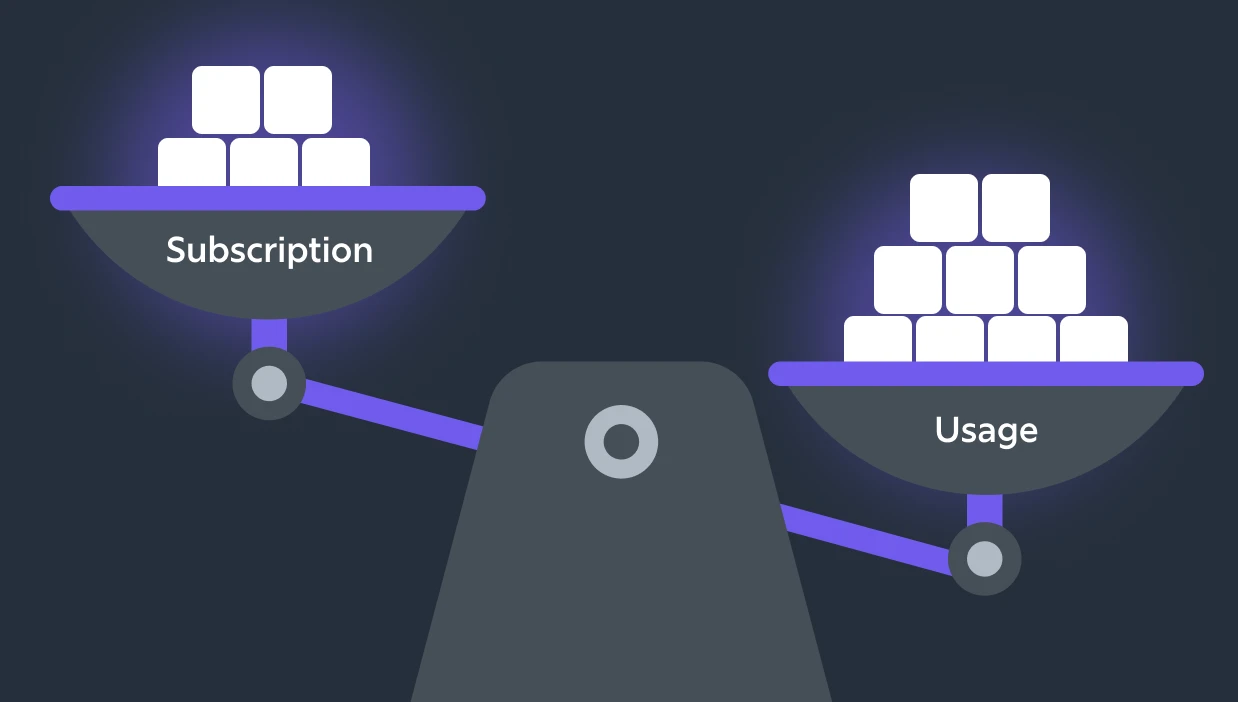
For product, pricing, and revenue leaders evaluating monetization models — a practical comparison of usage-based pricing and subscription pricing, outlining where each works best, the tradeoffs involved, and how customer behavior should guide the choice.
Usage-Based Pricing
Usage-based pricing charges customers based on their usage of a product or service. This model is particularly useful for businesses that offer services that have a variable usage pattern, such as data storage or cloud computing.
Pros
- Flexibility: Customers can scale their usage up or down as needed, making this model particularly useful for businesses that experience fluctuations in demand
- Fairness: Customers only pay for what they use, which can be seen as a fairer pricing model
- Incentivizes efficiency: Since customers are charged based on usage, they may be incentivized to use less and optimize their usage — a win-win for both parties
Cons
- Lack of predictability: Because customers are charged based on usage, their bills may vary from month to month, making budgeting and forecasting difficult
- Complexity: The usage-based model can be complex, particularly if there are different usage tiers or pricing structures — a potential turnoff for some customers
Subscription Pricing
Subscription pricing charges customers a recurring fee in exchange for access to a product or service. This model is particularly useful for businesses that offer ongoing services such as SaaS companies or media streaming services.
Pros
- Predictable revenue: Since customers are charged a recurring fee, revenue is predictable — making budgeting and forecasting easier
- Customer loyalty: Customers who subscribe may feel a sense of loyalty to the brand, resulting in long-term relationships and stable revenue
- Simplicity: Subscription pricing is straightforward and easy to understand for both vendors and buyers
Cons
- Lack of flexibility: Subscription pricing can be inflexible, as customers are often locked into a fixed period — a turnoff for customers who only need a product for a short period
- Potential for unused subscriptions: If a customer subscribes but doesn't use the service, they may still be charged for the full term — which can be seen as wasteful
Conclusion
Ultimately, the choice between usage-based pricing and subscription pricing will depend on the specific needs of the business and its customers. Businesses that offer services with a variable usage pattern may find that usage-based pricing is more appropriate, while those that offer ongoing services may find that subscription pricing is a better fit.
Many of today's leading B2B companies have found success with hybrid models — combining subscription commitments with usage-based overages, or offering prepaid credit pools that blend the predictability of subscriptions with the flexibility of consumption pricing. Carefully considering the pros and cons of each allows businesses to choose the option that works best for them and their customers.