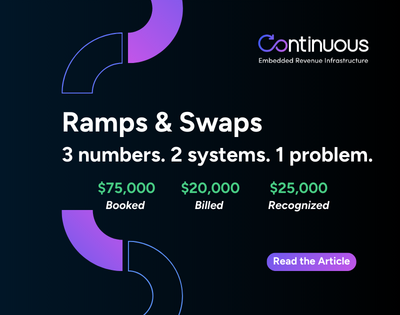
For CFOs, CROs, and RevOps leaders at mid-market SaaS companies: learn why ramps and swaps cause bookings, billings, and revenue to diverge in Salesforce and NetSuite — creating margin leakage, RPO reporting gaps, and a finance team reconciling numbers that should never have drifted.
- Ramps and swaps are standard in B2B SaaS — but they create a structural gap between what Salesforce records as booked and what NetSuite recognizes as earned under ASC 606
- Post-allocation, the financial value of a product sits seven records deep in NetSuite and never flows back to Salesforce. Companies silently donate 1–3% of ARR annually through incorrect swap credits
- ARR reflects bookings rather than recognized revenue, RPO is understated when ramp deals aren't configured correctly, and the CRO and CFO are reconciling different numbers
- Fixing this requires being native to both Salesforce and NetSuite — embedded in the transaction and revenue layers of both systems simultaneously
Why Do Ramps and Swaps Leave Sales Flying Blind and Finance Cleaning Up the Mess?
When an opportunity closes in Salesforce, the booking reflects what was sold: the price on the quote. But in NetSuite, two things happen that Salesforce will never see.
Allocation: When a deal includes a software license and a professional services engagement, the revenue has to be distributed across both components based on standalone value, not what the invoice says. A deal booked as $50,000 for software might become $30,000 for software and $20,000 for services once NetSuite applies allocation.
Recognition timing: A ramp deal — $20,000 in year one, $25,000 in year two, $30,000 in year three for the same product — can't be recognized as billed. The total contract value has to be spread evenly. So you recognize $25,000 annually regardless of what the invoice says. Year one generates an unbilled receivable. Year three generates deferred revenue. None of this is visible in Salesforce.
"The post-allocation financial picture that lives in NetSuite never makes its way back to Salesforce. In 99% of cases, only the most sophisticated organizations manage to close that gap — and they've had to build it themselves."
What Does It Really Cost When Ramps and Swaps Go Wrong?
The most immediate cost is margin leakage. When a customer wants to swap products, the account manager calculates their credit as $25,000 because that's what six months of a $50,000 contract looks like on paper — but the actual remaining recognized value might be $15,000 because of how allocation was applied.
The rep isn't cutting corners — they're working with the only number available to them. When systems aren't architected to surface the real revenue position, over-crediting isn't a training problem. It's the predictable outcome of asking people to make financial decisions without financial data.
Across PE-backed SaaS companies, it's common to see 1 to 3 percent of ARR effectively donated this way each year — purely because swap credits are based on invoice math instead of recognized revenue.
Why Can't Your Systems Handle Ramps and Swaps Automatically?
Because the revenue position that matters sits seven records deep in a system the sales team never touches. A deal moves through a chain: opportunity → order line in Salesforce → sales order → sales order line in NetSuite → revenue element → recognition plan → journal entries. By the time allocation has been applied and recognition has begun, the number relevant for a swap is buried at the end of that chain.
To get that number back to the person quoting the deal, someone has to manually bridge the gap. That's not a process. That's a workaround with a name badge.
How Does Continuous Solve the Ramps and Swaps Problem?
Continuous operates at the architectural boundary between Salesforce and NetSuite, embedded in both systems' transaction and revenue layers. It tracks the full lifecycle of a deal from opportunity through allocation, recognition, and journal entry.
For swaps, the account manager sees the actual remaining recognized value before they build the quote — not invoice math, not a CPQ estimate. For ramps, Continuous structures recognition correctly from the start and recalculates automatically when a contract changes.
On the reporting side, bookings, billings, and revenue reconcile structurally. The CRO and CFO operate from the same source of truth.
Frequently Asked Questions
What are ramps and swaps in SaaS contracts?
A ramp is a multi-year contract where the price increases by a pre-negotiated amount each year. A swap is a mid-contract product exchange where a customer returns the unused portion and applies the remaining credit toward a different product.
Why do ramps and swaps cause problems in NetSuite?
NetSuite applies revenue allocation and recognition rules that change the financial value of a product after a deal closes. These adjustments happen entirely in NetSuite and are never reflected back in Salesforce, creating a disconnect between what sales knows and what finance knows.
How does revenue allocation affect swap credits?
Allocation means the recognized value of a product can be materially different from what appears on the invoice. When a customer swaps that product, the credit owed is based on remaining recognized value, not the invoiced amount — but sales teams working from Salesforce routinely over-issue credits without knowing it.
What is Remaining Performance Obligation and how do ramps affect it?
RPO is the total contract revenue a company is obligated to recognize in the future but hasn't yet earned. For a three-year ramp deal, RPO represents significant forward revenue commitment. If ramp deals aren't configured correctly in NetSuite with even recognition, RPO will be understated.